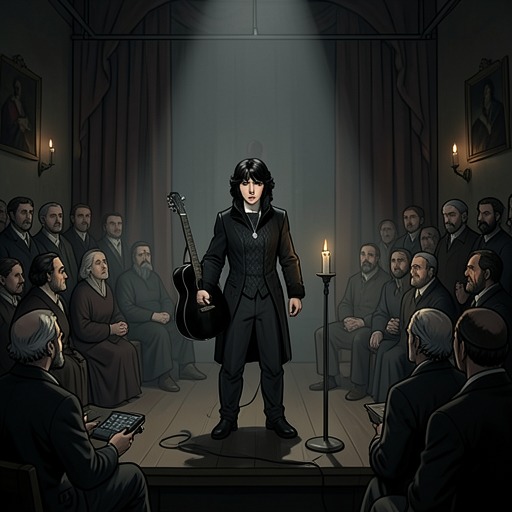
Jimmy Page
Lords of ChaosJimmy Page, guitarist of Led Zeppelin, is presented as a central link between late-1960s occult revival and the themes that would later preoccupy many Black Metal bands. His interest in Aleister Crowley was more serious than the Satanic dabbling attributed to Mick Jagger and the Rolling Stones: Page collected Crowley’s writings, invested in an occult bookshop, and owned Crowley’s former Scottish estate. Around him, musical influence, public performance, and rumor became difficult to separate.
Occult Interests and Crowley
The book sets Page’s interests against the spiritual restlessness of Flower Power. As sections of British and American youth moved away from Christianity and sought alternatives in Eastern mysticism, cults, and occultism, Crowley’s reputation rose anew through the underground films of Kenneth Anger. Page and Mick Jagger both scored soundtracks for Anger’s Crowley-inspired films, including Invocation of My Demon Brother and Lucifer Rising.
Page’s engagement extended well beyond that association. His collection of original Crowley books and manuscripts was described as among the world’s best, and he held a financial share in London’s Equinox occult bookshop, named after Crowley’s journal of “magick,” published from 1909 to 1914. Page also purchased Crowley’s former Scottish property, Boleskine Estate. Its reputation remained ominous under later ownership: the account notes that caretakers there were confined to mental asylums or died by suicide during their tenures.
In an interview about his attraction to Machiavelli’s strong-arm philosophy, Page said, “He was a master of evil, but you can’t ignore evil if you study the supernatural as I do ... I want to go on studying it.” He also defended Crowley’s continuing relevance: “I think Aleister Crowley’s completely relevant to today. We’re all still seeking for truth—the search goes on ... Magic is very important if people can go through with it.” These remarks place Page’s interest in the occult as an ongoing pursuit, not merely an image attached to the band.
Music and Mythic Imagery
Crowley’s Thelemic religion appears, in the book’s account, among the influences woven through Led Zeppelin’s albums, alongside Anglo-Saxon and Norse heathen folklore, traditional music, and the literary mythology of J. R. R. Tolkien. Page’s composition for “No Quarter” offers a concentrated example of how those strands met. Stephen Davis, in his book Hammer of the Gods, remarks that the music inspired Robert Plant to write lyrics imagining Led Zeppelin as a Viking death squad riding the winds of Thor toward a Satanic destiny.
The account treats Led Zeppelin as an early band whose music and imagery anticipate themes later prominent in Black Metal, while acknowledging that the band’s classification as “Heavy Metal” remains debatable. The point is not that every influence had a single meaning, but that myth, occult references, and a deliberately threatening atmosphere were brought together in the group’s artistic world.
Reputation, Rumor, and Retrenchment
Led Zeppelin also cultivated its sinister reputation through public spectacle. The band staged a record-release party as a mock Black Mass in underground caves where Sir Francis Dashwood and his Hellfire Club had held similar rites two centuries earlier. In its heyday, the band—and Page especially—understood the value of notoriety, echoing Crowley’s own use of a disturbing public image.
Rumors followed: one alleged that the band had signed a pact with the Devil in exchange for success; another claimed Page’s experiments with black magic had brought about drummer John Bonham’s death. The book presents these as stories circulating around the band, not established facts. In later years, former members sought to minimize their association with the occult. Plant and Page dismissed Boleskine Estate as nothing more than an old “pig farm,” a sharp contrast with the sinister reputation that had gathered around it.